

Custom CRM vs White Label CRM for Forex Brokers: Which Is Better?
Aug 08, 2026 • Blog
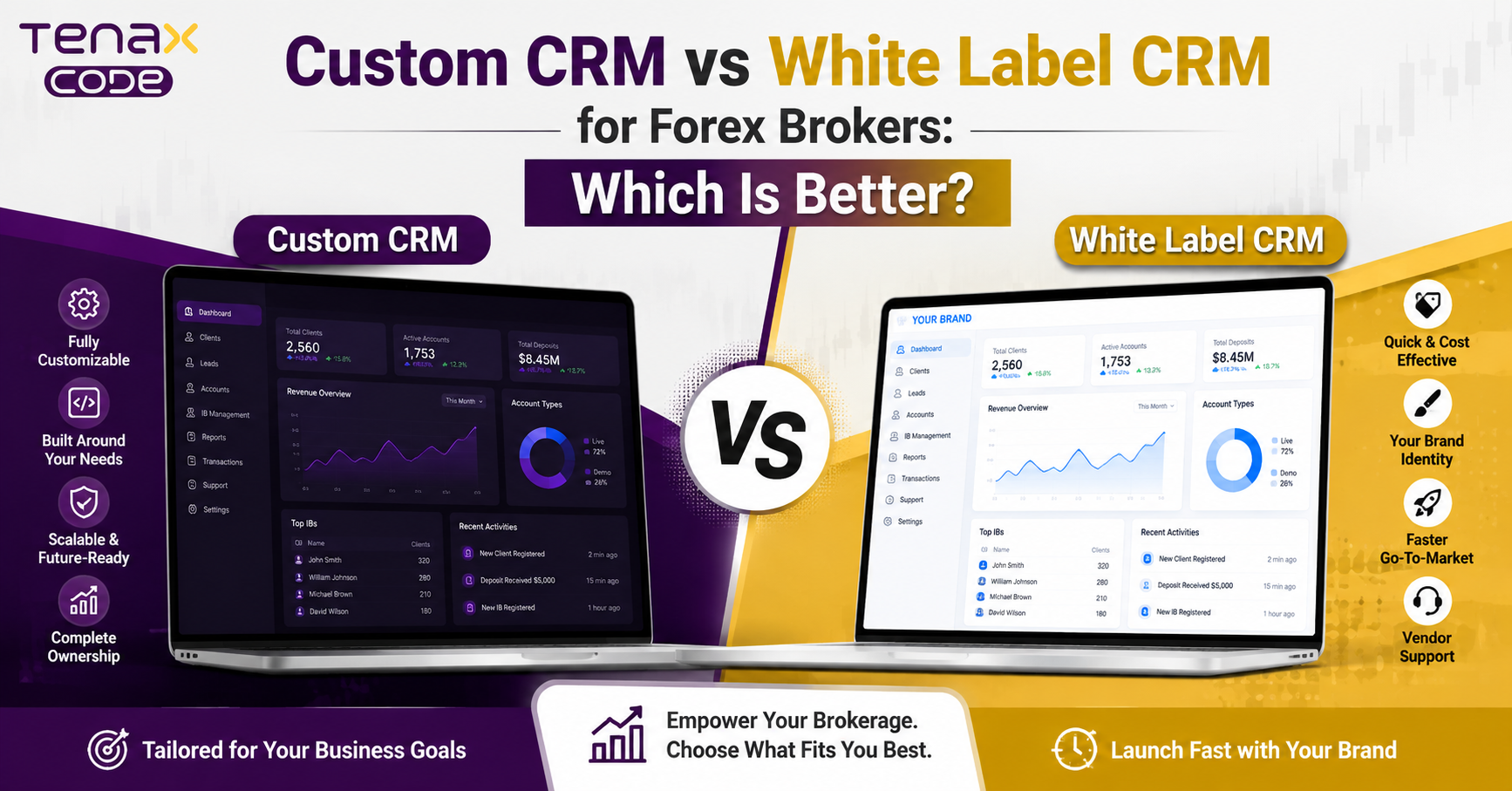
Choosing the right CRM for Forex brokers is an important technology decision. A CRM affects how brokers manage leads, clients, sales teams, KYC processes, deposits, withdrawals, IBs, reporting, and overall customer relationships.
For Forex brokers, there are generally two approaches: custom CRM development and white label CRM solutions. Both options can support a brokerage business, but they differ significantly in cost, development time, flexibility, scalability, maintenance, and customization.
So, which option is better for your brokerage?
The answer depends on your business model, budget, technical requirements, growth plans, and how much control you want over your technology infrastructure.
In this guide, we compare custom CRM and white label CRM for forex brokers to help you make a more informed decision.
What Is a Forex Broker CRM?
A forex broker CRM is a specialized customer relationship management system designed for the operational requirements of forex and financial trading businesses.
Unlike a traditional CRM, a forex-focused CRM can connect customer management with brokerage workflows such as:
- Lead and client management
- KYC and document management
- Trading account management
- Deposit and withdrawal tracking
- IB and affiliate management
- Client segmentation
- Sales team management
- Communication and notifications
- Reports and analytics
- Trading platform integration
- Payment gateway integration
- Multi-level IB structures
- Automated workflows
A well-designed CRM can help brokers improve operational efficiency while providing sales and support teams with a centralized view of client activity.
What Is a Custom CRM for Forex Brokers?
A custom CRM is developed specifically according to the requirements of a brokerage business.
Instead of adapting an existing system, the broker works with a Forex CRM provider or development team to create a solution with selected features, workflows, integrations, and interfaces.
Advantages of Custom CRM
1. Maximum customization
Custom development allows brokers to create workflows around their specific business processes. Features can be designed according to the broker's requirements rather than being limited to predefined functionality.
2. Greater control
The broker can have greater control over the CRM architecture, user roles, integrations, dashboards, and future development roadmap.
3. Scalability
If the brokerage expects significant growth, a custom CRM can be designed with future expansion in mind.
4. Unique business processes
Brokers with specialized operations, unique commission structures, or complex partner models may benefit from custom functionality.
Disadvantages of Custom CRM
The biggest drawback is usually the initial investment and development time.
Custom development may require:
- Higher upfront costs
- Longer development cycles
- Testing and quality assurance
- Ongoing maintenance
- Dedicated technical resources
- Integration development
For a new brokerage that wants to launch quickly, these factors can become significant.
What Is a White Label CRM for Forex Brokers?
A Forex Broker Whitelabel CRM is a ready-made CRM platform provided by a technology company and offered under the broker's brand or configured for its business requirements.
Instead of developing the complete CRM from scratch, the broker uses an existing platform that already contains core brokerage-management functionality.
This approach can significantly reduce the time required to deploy a CRM.
Advantages of White Label CRM
1. Faster deployment
A ready-made CRM can generally be configured and launched much faster than building an entirely new platform.
2. Lower initial investment
Because the core technology has already been developed, brokers may avoid the substantial upfront development costs associated with building a CRM from scratch.
3. Pre-built functionality
Many white label solutions can provide commonly required features such as client management, KYC workflows, IB management, reporting, and integrations.
4. Easier maintenance
The technology provider can handle platform updates, improvements, bug fixes, and technical maintenance depending on the service agreement.
5. Suitable for new brokers
A white label approach can be particularly useful for startups and brokers that want to focus their resources on marketing, client acquisition, compliance, and business development rather than building technology infrastructure.
Custom CRM vs White Label CRM: Key Differences
| Factor | Custom CRM | White Label CRM |
|---|---|---|
| Development | Built specifically for the broker | Pre-built platform |
| Initial cost | Generally higher | Generally lower |
| Launch time | Longer | Faster |
| Customization | Very high | Depends on provider |
| Maintenance | Broker/development team | Usually provider-supported |
| Scalability | Designed according to requirements | Depends on platform |
| Integrations | Highly customizable | Available integrations vary |
| Branding | Fully customizable | Branding options available |
| Best for | Established or specialized brokers | Startups and fast-growing brokers |
Which CRM Is Better for Forex Brokers?
There is no universal answer.
A custom CRM may be the better choice if your brokerage requires highly specialized workflows, proprietary functionality, complex integrations, or complete control over the technology stack.
On the other hand, a white label CRM can be a better option if you want faster deployment, predictable implementation, lower initial development requirements, and access to established brokerage-management features.
For many new and growing brokers, starting with a white label solution can provide a practical balance between functionality, speed, and investment.
As the business grows, additional customization or integrations can be considered based on actual operational requirements.
What Should You Consider Before Choosing a Forex CRM Provider?
Before selecting a Forex CRM provider, don't evaluate the platform based only on its feature list.
Consider the following:
1. Integration capabilities
Check whether the CRM can integrate with your trading platforms, payment gateways, KYC providers, communication tools, and other systems.
2. Security and access control
Client and financial information requires appropriate security controls. Review user permissions, authentication, data protection practices, and access management.
3. Scalability
Ask how the platform performs as your number of clients, IBs, transactions, and internal users increases.
4. Support and maintenance
Understand what technical support, updates, troubleshooting, and maintenance are included.
5. Customization
Determine whether you can modify dashboards, workflows, reports, user roles, commissions, and integrations when your business requirements change.
6. Total cost of ownership
Don't compare only the initial price. Consider implementation, customization, integrations, maintenance, support, upgrades, and future development costs.
Why Choose TenaxCode for Forex CRM Solutions?
For brokers comparing Forex broker solutions, TenaxCode provides technology-focused solutions designed around the operational requirements of forex businesses.
Whether you are evaluating a ready-to-deploy CRM or require a more customized brokerage technology setup, the right approach should begin with understanding your business model, operational workflows, integrations, and growth objectives.
A professional forex CRM solution should not simply store client information. It should help connect different parts of the brokerage operation and give teams better visibility into leads, clients, partners, transactions, and performance.
Final Verdict: Custom or White Label CRM?
The choice between custom and white label CRM ultimately depends on your brokerage's priorities.
Choose custom CRM if: you need extensive customization, unique workflows, specialized integrations, and maximum control.
Choose white label CRM if: you want faster deployment, lower initial development requirements, proven core functionality, and easier ongoing management.
For businesses entering the forex market or looking to launch quickly, a white label solution can be a practical starting point. Established brokers with highly specific technology requirements may find greater long-term value in custom development.
Before making a decision, compare the features, integrations, scalability, security, support, customization options, and total cost of ownership offered by each forex broker CRM provider.
The right CRM is not simply the one with the most features—it is the one that best fits your brokerage's current requirements while supporting its future growth.
Frequently Asked Questions About Forex CRM Solutions
1. What is a forex broker CRM?
A forex broker CRM is a specialized customer relationship management platform designed for the operational needs of forex brokers. It can help manage leads, clients, KYC processes, trading accounts, IBs, sales teams, deposits, withdrawals, reporting, and third-party integrations from a centralized system.
2. Why do forex brokers need a specialized CRM?
A specialized CRM for forex brokers is designed around brokerage-specific workflows. It can help brokers streamline lead management, client onboarding, KYC, sales operations, IB management, reporting, and communication while giving teams better visibility into client and business activities.
3. What is the difference between custom CRM and white label CRM for forex brokers?
A custom CRM is developed around the specific requirements of a brokerage and offers greater flexibility and control. A white label CRM uses an existing platform that can be branded and configured for the broker. Custom CRM is generally more suitable for highly specialized requirements, while white label solutions can be useful for brokers looking for faster deployment.
4. Does TenaxCode provide CRM solutions for forex brokers?
Yes. TenaxCode provides forex CRM solutions designed to support the operational and client-management requirements of forex businesses. Depending on the brokerage's requirements, the solution can be tailored around areas such as client management, IB management, KYC workflows, reporting, integrations, and other brokerage operations.
5. Can TenaxCode customize a forex broker CRM?
Yes. Customization can be considered based on the broker's business model and operational requirements. Depending on the project, customization may include workflows, dashboards, user roles, reports, integrations, commission structures, and other CRM functionality.
6. Does TenaxCode offer white label forex broker CRM solutions?
TenaxCode can help businesses evaluate and implement suitable forex broker solutions, including CRM requirements where a faster, ready-made approach is preferred. The available branding, customization, integrations, and deployment options depend on the specific solution and project requirements.
7. What features should I look for in a forex broker CRM?
A reliable forex broker CRM should support essential brokerage workflows such as lead management, client onboarding, KYC and document management, trading account management, IB and affiliate management, deposit and withdrawal tracking, sales management, reporting, user permissions, notifications, and third-party integrations.
8. How do I choose the right forex CRM provider?
When choosing a forex CRM provider, evaluate the platform's features, customization capabilities, integrations, scalability, security practices, technical support, implementation process, and total cost of ownership. It is also important to choose a provider that understands the operational requirements of forex brokerage businesses.
9. Can a forex CRM integrate with trading platforms and payment gateways?
Yes, forex CRM solutions can be designed or configured to integrate with trading platforms, payment gateways, KYC providers, communication systems, and other brokerage technologies. Before selecting a CRM, brokers should confirm that the required integrations are supported.
10. Is a custom CRM better than a white label CRM for a forex broker?
It depends on the broker's requirements. A custom CRM may be better for established businesses requiring unique workflows, advanced integrations, or greater control. A white label CRM may be more suitable for brokers that prioritize faster deployment and established functionality. TenaxCode can help businesses determine which approach aligns with their operational and growth requirements.