

What Is a Prop Firm CRM and Why Does Your Trading Firm Need One?
Oct 06, 2026 • Blog
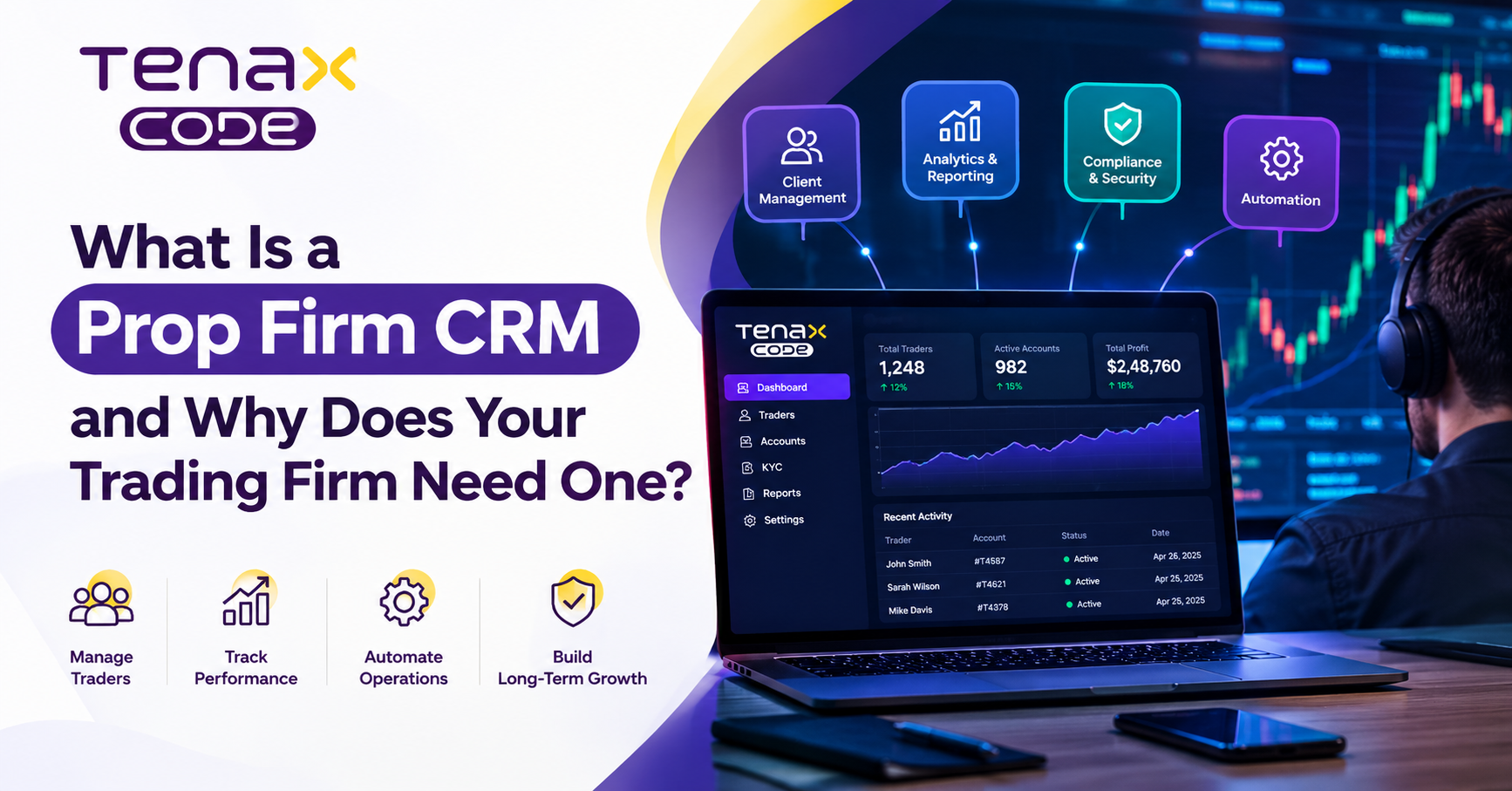
The proprietary trading industry is becoming increasingly technology-driven, with prop firms managing large communities of traders, complex evaluation programs, payments, trading accounts, and customer interactions. As operations grow, managing everything through spreadsheets, emails, and disconnected tools can quickly become inefficient.
This is where a prop firm CRM can make a significant difference.
A Prop Firm CRM is a specialized customer relationship management system designed to help proprietary trading firms manage traders, leads, accounts, evaluations, payments, communication, and operational workflows from a centralized platform.
For growing trading firms, the right prop firm CRM software can improve operational efficiency, provide better visibility into trader activity, and create a more organized experience for both the firm and its customers.
What Is a Prop Firm CRM?
A prop firm CRM is a technology platform designed specifically for proprietary trading businesses. Unlike a conventional CRM that primarily manages sales leads and customer relationships, a prop firm CRM can be customized to meet a trading firm's unique operational requirements.
It can help firms manage the complete trader life cycle—from the initial inquiry and registration to evaluation, account management, communication, and ongoing support.
Depending on the platform, a prop firm CRM system may include features such as:
- Lead and customer management
- Trader registration and onboarding
- Challenge or evaluation management
- Trading account management
- Payment and transaction tracking
- Affiliate and partner management
- Automated notifications
- Customer support management
- Reporting and analytics
- KYC and verification workflows
- Role-based access and administration
By bringing these processes together, a CRM can help prop firms reduce manual work and create a more structured operational environment.
How Does a Prop Firm CRM Work?
A prop firm CRM generally serves as a centralized platform that connects different areas of a firm's operations.
For example, when a potential trader registers on a prop firm's website, their information can be captured in the CRM. The firm can then track their onboarding progress, selected evaluation program, payment status, account information, and communication history.
Instead of employees switching between multiple systems, relevant information can be organized within a single interface.
A typical workflow may look like:
Lead → Registration → Verification → Payment → Challenge/Evaluation → Trading Account → Support → Ongoing Relationship
The exact workflow depends on the firm's business model and technology infrastructure. However, the primary objective remains the same: centralize information and streamline day-to-day operations.
Why Does Your Trading Firm Need a Prop Firm CRM?
As a prop firm grows, operational complexity grows with it. Managing hundreds or thousands of traders manually can lead to delays, duplicate data, communication gaps, and reporting difficulties.
Here are some of the key reasons a trading firm may benefit from a prop firm CRM system.
1. Centralized Trader Management
A prop firm may have large numbers of registered traders at different stages of their journey.
A CRM allows businesses to organize trader information in one centralized system. Teams can quickly access relevant customer details, account information, transaction history, and communication records.
This can make trade management more organized and efficient.
2. Automated Lead Management
Generating leads is only the first step in building a successful prop trading business. Firms also need an efficient process for following up with prospects and converting them into customers.
Prop firm CRM software can help organize leads according to their status, source, interest, or stage in the conversion funnel.
Automated follow-ups, notifications, and lead segmentation can help sales teams manage prospects more consistently.
3. Better Trader Onboarding
A complicated onboarding process can create unnecessary friction for traders.
A CRM can help firms structure the onboarding journey by managing registration details, verification requirements, selected programs, and other relevant information.
This gives teams greater visibility into where each trader is in the onboarding process.
4. Efficient Challenge Management
Many proprietary trading firms operate evaluation or challenge programs. Managing these programs at scale can become difficult without proper systems.
A specialized prop firm CRM can help organize trader participation and connect relevant customer information with evaluation-related workflows.
This can give administrators a clearer overview of active traders and their respective stages.
5. Payment and Transaction Tracking
Payments are an important part of a prop firm's operations.
Depending on the CRM's integrations and configuration, businesses can use the system to monitor payment-related information, transaction status, customer purchases, and other financial workflows.
Centralized payment information can also make it easier for support and operations teams to respond to customer queries.
6. Improved Customer Communication
Traders may contact a prop firm about account access, payments, evaluations, verification, or other issues.
A CRM can centralize customer information and communication history, allowing support teams to understand the customer's situation before responding.
This can contribute to a more consistent and professional customer experience.
7. Reporting and Business Insights
Data is essential for making informed business decisions.
A prop firm CRM system can provide dashboards and reports covering areas such as lead performance, trader registrations, customer activity, payment information, and other operational metrics.
These insights can help management identify trends and evaluate business performance.
Key Features to Look for in Prop Firm CRM Software
Not every CRM is designed for the proprietary trading industry. When evaluating prop firm CRM solutions, businesses should consider whether the platform can support their specific operational requirements.
Important features may include:
Trader & Customer Management
The system should provide a structured way to manage trader profiles, account information, interactions, and relevant records.
Lead & Sales Automation
Lead capture, segmentation, follow-ups, and sales pipeline management can help firms improve their customer acquisition process.
Challenge Management
If the firm offers evaluation programs, the CRM should support workflows associated with registrations, challenges, and trader progression.
Payment Integration
Integration with relevant payment providers can help streamline payment-related processes and improve transaction visibility.
Communication Automation
Email notifications, alerts, and automated customer communications can reduce repetitive administrative work.
Reporting & Analytics
Custom dashboards and reports can help management understand business performance and operational trends.
Security & Access Control
Because trading firms handle sensitive customer and operational information, appropriate security measures, permissions, and role-based access are important considerations.
Scalability
The system should be capable of supporting business growth without becoming difficult to manage as trader numbers and operational requirements increase.
Prop Firm CRM vs. Traditional CRM
A traditional CRM is generally designed around standard sales and customer relationship management.
A prop firm CRM, on the other hand, can be tailored to the specific workflow of proprietary trading businesses.
For example, a traditional CRM may focus primarily on:
- Leads
- Sales pipelines
- Contacts
- Customer communication
A specialized prop firm CRM may additionally support:
- Trader onboarding
- Evaluation programs
- Trading account workflows
- Payment processes
- Affiliate management
- Trader-related reporting
- Prop-firm-specific automation
Therefore, firms should evaluate CRM platforms based on their actual operational requirements rather than simply choosing a generic CRM.
How TenaxCode Can Help
For a growing proprietary trading business, selecting the right technology partner is an important decision. TenaxCode provides technology solutions designed to support modern trading businesses and their operational requirements.
A well-designed prop firm CRM solution can help bring customer management, operational workflows, automation, and reporting into a more centralized environment.
When evaluating a CRM provider, firms should consider factors such as customization, scalability, integrations, security, user experience, support, and the ability to adapt the platform to their business model.
The right technology should not simply store customer information—it should help make business operations more organized and efficient.
Final Thoughts
A prop firm CRM is more than a database for storing trader information. It can become an important part of a proprietary trading firm's technology infrastructure, connecting customer management, onboarding, evaluations, payments, communication, and reporting.
For firms operating in India and international markets, adopting the right prop firm CRM software can help reduce manual processes, improve operational visibility, and create a more structured experience for traders.
As the proprietary trading industry continues to evolve, firms that invest in scalable technology and efficient workflows can be better positioned to manage growth.
If your trading business is looking for a technology-driven approach to managing traders and operations, exploring specialized prop firm CRM solutions can be an important step toward building a more efficient and scalable business.
Frequently Asked Questions (FAQs)
What is a Prop Firm CRM?
A Prop Firm CRM is a customer relationship management platform specifically designed for proprietary trading firms. It can help manage traders, leads, onboarding, evaluations, payments, communication, and business operations from a centralized system.
Why is CRM software important for a prop firm?
CRM software can help prop firms organize customer data, automate repetitive processes, manage leads, improve communication, and gain better visibility into business operations.
What features should prop firm CRM software have?
Important features can include trader management, lead management, onboarding, challenge management, payment integrations, communication automation, reporting, analytics, security, and scalability.
Can a Prop Firm CRM be customized?
Yes. Depending on the provider and platform architecture, a prop firm CRM system can be customized to support a firm's specific workflows, integrations, user roles, and operational requirements.
Is a Prop Firm CRM useful for growing trading firms?
Yes. As trader numbers and business operations increase, centralized CRM software can help firms manage information and workflows more efficiently while reducing reliance on manual processes.
How do I choose the right Prop Firm CRM solution?
Consider the platform's features, scalability, customization options, integrations, security, reporting capabilities, user experience, and technical support. The CRM should align with your firm's current requirements and future growth plans.