

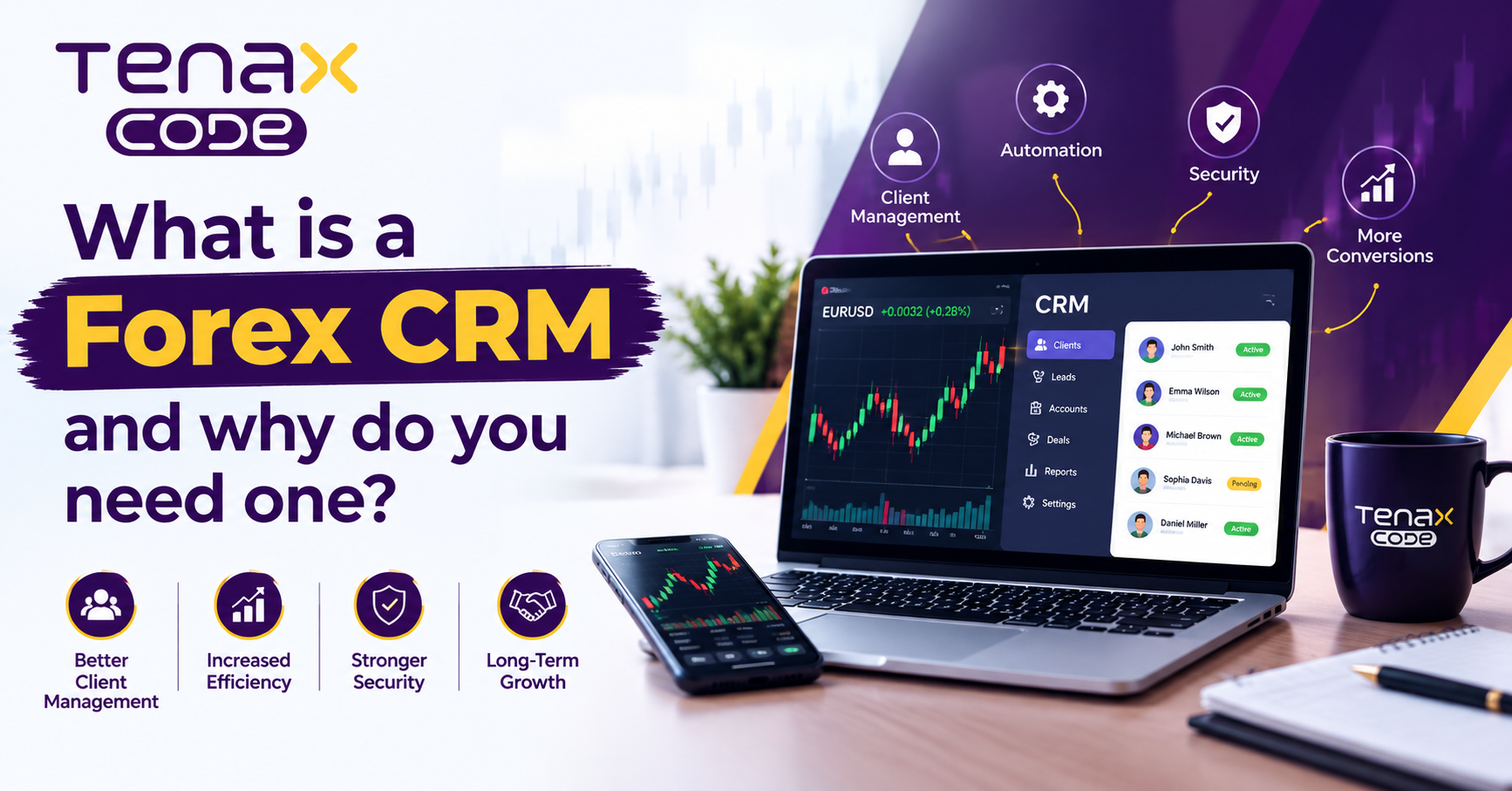
The foreign exchange (Forex) market is highly competitive, and brokers need more than a trading platform to manage their business effectively. As the number of traders, leads, transactions, and support requests grows, managing customer information manually can become difficult and inefficient. This is where Forex CRM software becomes an important part of a modern brokerage operation.
A Forex CRM helps brokers organize customer data, manage leads, improve communication, automate routine processes, and coordinate different parts of their business from one centralized system. For Forex businesses operating in India and international markets, the right CRM can improve operational efficiency while creating a more structured customer experience.
What Is a Forex CRM?
A Forex CRM (Customer Relationship Management) system is specialized software designed to help Forex brokers manage relationships with traders, leads, affiliates, and other business partners.
Unlike a general-purpose CRM, a Forex CRM is designed around the specific requirements of the foreign exchange industry. It can connect customer management with important brokerage operations, including account management, lead tracking, communication, reporting, and back-office activities.
A typical Forex broker CRM can provide a centralized dashboard where brokerage teams can monitor customer information and track activities throughout the customer life cycle—from the first inquiry and registration to account activation and ongoing support.
In simple terms, a Forex CRM helps brokers answer important questions such as:
• Where did a lead come from?
• Has the lead completed registration?
• Has the client submitted required documents?
• What is the client's account status?
• Which customers require follow-up?
• How is the sales team performing?
• Which marketing channels are generating better leads?
Having this information organized in one system can make daily brokerage operations more manageable.
Why Do Forex Brokers Need CRM Software?
Managing a Forex brokerage involves multiple departments and processes. Sales teams handle leads, customer support assists traders, compliance teams manage documentation, and management needs accurate reports.
Without a centralized system, important information can become scattered across spreadsheets, emails, messaging applications, and different software tools.
Here are some of the major reasons brokers use Forex CRM solutions.
1. Centralized Customer Management
A Forex CRM stores important customer information in one centralized environment. Sales and support teams can access relevant information without repeatedly searching through different systems.
A centralized customer database can help brokers maintain better records and understand each customer's journey.
This is particularly useful as a brokerage grows and starts managing hundreds or thousands of clients.
2. Better Lead Management
Lead generation is an important part of growing a Forex brokerage. However, generating leads is only the first step. Brokers also need an effective process for qualifying, following up, and converting those leads.
Forex CRM software can help sales teams organize leads according to different stages, such as:
• New lead
• Contacted
• Qualified
• Registered
• Account activated
• Deposit completed
• Active client
Automated reminders and lead assignment can also reduce the possibility of leads being overlooked.
3. Improved Sales Performance
A CRM gives sales managers greater visibility into their team's activities.
Managers can monitor lead sources, conversion stages, follow-up activities, and sales performance through dashboards and reports. This information can help identify bottlenecks in the sales funnel and improve the overall customer acquisition process.
Instead of relying entirely on manual spreadsheets, teams can use centralized data to make more informed operational decisions.
4. Automated Communication
Following up with every lead and client manually can consume considerable time.
Many modern Forex CRM solutions support automated communication workflows, allowing brokers to send predefined emails, notifications, reminders, and other communications based on specific customer actions.
For example, a system may trigger a communication after a user registers, completes a particular step, or requires additional assistance.
Automation does not replace human interaction. Instead, it helps teams spend more time on high-value customer interactions while reducing repetitive administrative work.
5. Efficient Client Onboarding
Client onboarding can involve multiple stages, including registration, documentation, account setup, and verification.
A Forex CRM can help organize these activities and provide teams with visibility into the current status of each client.
When onboarding information is centralized, employees can identify pending actions more quickly and provide customers with a smoother experience.
For brokers operating in India or serving Indian clients, the exact onboarding and compliance process should be designed according to applicable laws, regulations, and the brokerage's business model.
6. Integration With Brokerage Systems
One of the key differences between a standard CRM and a Forex CRM is the ability to work alongside brokerage technology.
Depending on the provider and configuration, a CRM may integrate with trading platforms, payment systems, websites, lead-generation channels, communication tools, and other brokerage infrastructure.
These integrations can reduce duplicate data entry and help different teams work with more consistent information.
When evaluating a Forex crm provider, brokers should therefore consider not only CRM features but also the provider's integration capabilities.
What Is a Forex Backoffice Solution?
A Forex Backoffice solution focuses on the operational side of running a brokerage. While the CRM primarily helps manage customer relationships and business processes, a back-office system can support administrative and operational activities behind the trading experience.
Depending on the solution, back-office functionality may include:
• Client account management
• Transaction monitoring
• Reporting
• Documentation management
• User and role management
• Payment-related workflows
• Commission management
• Affiliate or IB management
• Operational dashboards
A CRM and back-office solution can work together to create a more connected brokerage ecosystem.
For growing brokers, this combination can reduce manual processes and give management better visibility across different business functions.
Key Features to Look for in Forex CRM Software
Not every CRM is suitable for a Forex brokerage. Before choosing a system, businesses should evaluate whether it meets their operational requirements.
Important features may include:
Lead and Contact Management
The system should allow teams to capture, organize, assign, and track leads throughout the sales funnel.
Client Management
Brokers should be able to maintain structured customer profiles and monitor important account information.
Reporting and Analytics
Dashboards and reports can help management evaluate sales activity, lead conversion, customer activity, and operational performance.
Automation
Automated workflows can reduce repetitive tasks and help teams maintain consistent follow-up processes.
Integrations
The CRM should be capable of integrating with the tools and platforms already used by the brokerage.
Security and Access Control
Because brokerage systems handle sensitive customer and business information, appropriate security controls, authentication, user permissions, data protection, and audit capabilities are important considerations.
Scalability
A CRM should be capable of supporting business growth without creating unnecessary operational limitations.
How to Choose the Right Forex CRM Provider
Selecting the right Forex CRM provider is an important business decision. Brokers should evaluate providers based on functionality, integration capabilities, security practices, technical support, customization, scalability, and experience with brokerage workflows.
Instead of selecting a CRM based solely on the number of features, businesses should first identify their operational requirements.
Consider questions such as:
• Can the CRM integrate with our existing technology?
• Can it support our expected number of users and clients?
• Does it provide suitable reporting?
• Can workflows be customized?
• What level of technical support is available?
• How does the provider handle security and access control?
• Can the system scale as the brokerage grows?
A detailed product demonstration and technical discussion can help determine whether a solution is suitable for a specific brokerage.
Benefits of Using Forex CRM Solutions
A properly implemented CRM can provide several business benefits, including:
Better organization: Customer and lead information remains centralized.
Improved productivity: Automation can reduce repetitive administrative work.
Faster follow-ups: Sales teams can identify leads that require attention.
Better visibility: Managers can access reports and dashboards to understand business performance.
Improved customer experience: Teams can access relevant information more quickly when assisting clients.
Scalability: A structured system can make it easier to manage increasing numbers of customers and leads.
Why TenaxCode for Forex CRM Solutions?
For Forex businesses looking for technology solutions, TenaxCode focuses on developing software solutions designed around business requirements. When evaluating a technology partner, brokers should look for a provider that understands CRM workflows, brokerage operations, integrations, scalability, and the importance of secure handling of business data.
The right implementation should not simply add another software tool to the organization. It should connect relevant processes and help teams operate more efficiently.
Final Thoughts
A Forex CRM is more than a database for storing customer information. It can become a central component of a brokerage's sales, customer management, automation, and operational workflow.
For growing Forex businesses, Forex CRM software, Forex CRM solutions, and a well-integrated Forex back office solution can help create a more organized and scalable operating environment.
However, the best solution depends on the brokerage's business model, technology stack, target market, compliance requirements, and growth plans. Businesses should carefully evaluate CRM features, integrations, security, scalability, and provider support before making a decision.
For Forex brokers in India and other markets, investing in the right Forex broker CRM can be an important step toward improving operational efficiency and delivering a more consistent customer experience.
Frequently Asked Questions
1. What is a Forex CRM?
A Forex CRM is specialized customer relationship management software designed for Forex brokers. It helps manage leads, clients, communications, onboarding processes, sales activities, reporting, and other brokerage-related workflows from a centralized platform.
2. Why do Forex brokers need CRM software?
Forex brokers use CRM software to organize customer data, manage leads, automate repetitive processes, improve follow-ups, monitor sales performance, and provide more efficient customer support. It becomes increasingly useful as the brokerage grows.
3. What features should Forex CRM software have?
Important features can include lead management, client management, automated workflows, reporting and analytics, communication tools, user permissions, integrations, onboarding management, and scalable infrastructure. The required features depend on the brokerage's business model and operational needs.
4. What is the difference between a Forex CRM and a Forex Backoffice solution?
A Forex CRM primarily focuses on customer relationships, lead management, sales, communication, and client workflows. A Forex Backoffice solution generally focuses on operational and administrative functions such as account management, reporting, commissions, documentation, and other brokerage processes. The two systems can complement each other.
5. Can Forex CRM solutions integrate with trading platforms?
Yes, depending on the CRM provider and technical architecture, Forex CRM solutions can be integrated with trading platforms and other brokerage systems. Brokers should confirm the specific integrations, APIs, customization options, and technical requirements with the provider before implementation.
6. How can TenaxCode help with Forex CRM solutions?
TenaxCode can help Forex businesses explore technology solutions based on their operational requirements. A suitable CRM implementation can bring together lead management, client workflows, automation, reporting, and integrations to create a more structured brokerage environment.
7. How do I choose the right Forex CRM provider?
When selecting a forex crm provider, consider factors such as industry experience, CRM functionality, integrations, customization, scalability, security practices, technical support, reporting capabilities, and total implementation requirements. A product demonstration and technical consultation can help you compare providers more effectively.
8. Is a Forex CRM useful for a growing brokerage?
Yes. A CRM can provide a structured way to manage increasing numbers of leads and clients. Automation, centralized customer information, reporting, and workflow management can help reduce manual work and support operational scalability.
9. Can a Forex CRM improve customer experience?
A well-designed CRM can improve customer experience by helping teams access relevant customer information, respond to inquiries more efficiently, manage follow-ups, and maintain more consistent communication throughout the customer lifecycle.
10. Why choose TenaxCode for a Forex broker CRM?
Choosing a technology partner should be based on the brokerage's specific requirements rather than a feature checklist alone. TenaxCode can be considered by Forex businesses looking for tailored Forex CRM software, brokerage technology, integrations, and workflow solutions designed around their operational needs.