

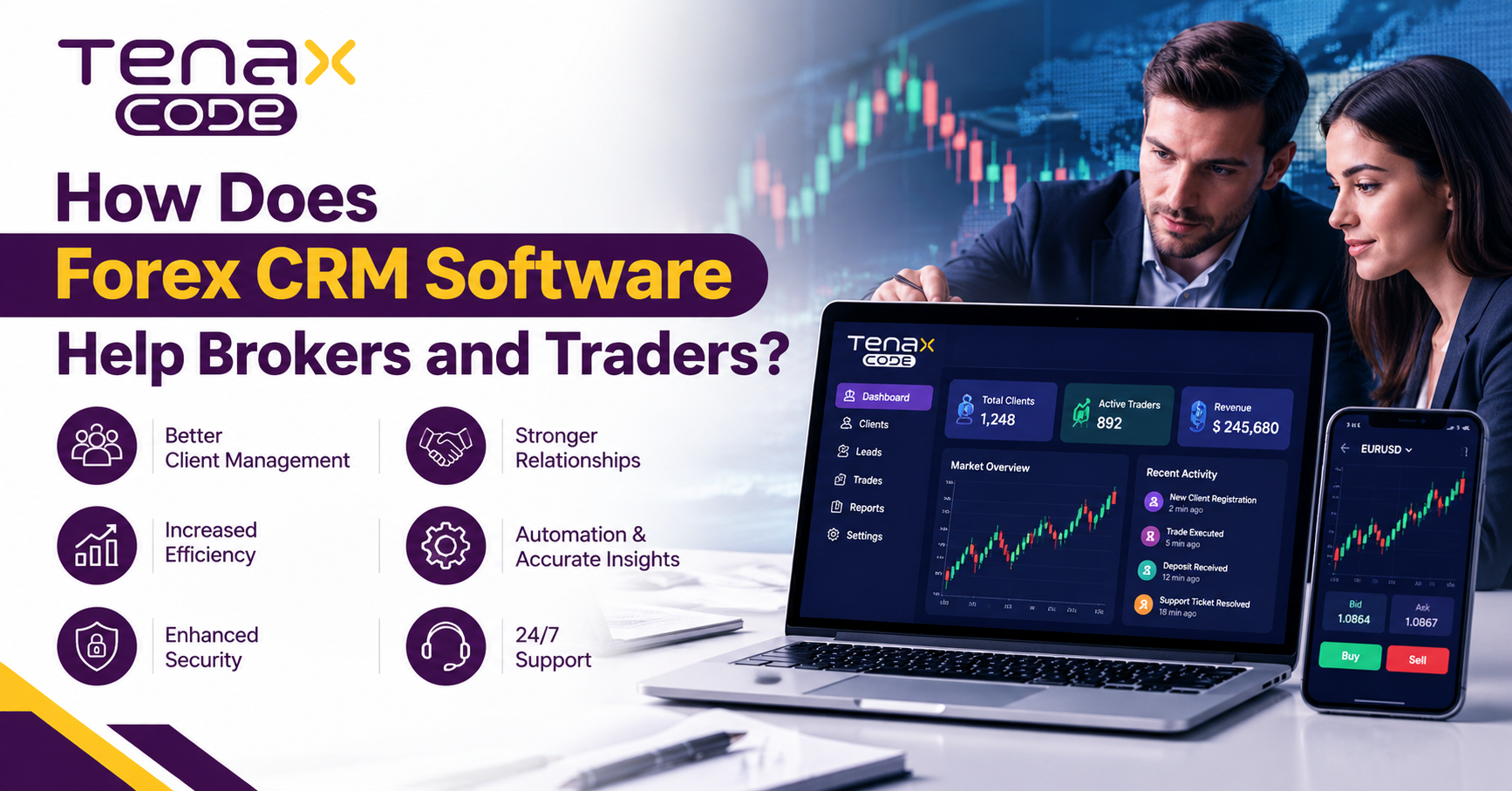
The Forex market is highly competitive, and brokers need more than a trading platform to build long-term relationships with clients. Efficient customer management, quick communication, secure data handling, and streamlined operations are essential for delivering a professional trading experience. This is where Forex CRM software plays an important role.
A dedicated CRM system helps Forex brokers organize client information, manage leads, automate routine processes, and improve communication between brokers and traders. For businesses looking to scale their forex operations, choosing the right Forex CRM solutions can improve operational efficiency while supporting better customer experiences.
For forex businesses in India and international markets, TenaxCode provides technology solutions designed to help brokers manage their customer lifecycle and back-office operations more efficiently.
What Is Forex CRM Software?
Forex CRM software is a customer relationship management system specifically designed for forex brokers and trading businesses. Unlike a traditional CRM, a forex-focused CRM is built around the requirements of brokers, traders, affiliates, sales teams, compliance teams, and back-office staff.
A typical Forex CRM can bring important customer and operational activities into one centralized system. Depending on the solution, brokers can manage leads, trader accounts, deposits, withdrawals, communications, sales activities, and reporting from a single interface.
A well-designed Forex broker CRM can therefore become an important part of a broker's technology infrastructure.
How Does Forex CRM Software Help Forex Brokers?
1. Centralized Client Management
Managing customer information across spreadsheets, emails, messaging applications, and separate systems can become difficult as a brokerage grows.
Forex CRM software centralizes important client information, allowing authorized teams to access relevant customer data from one platform. Sales representatives can track leads, while support and account-management teams can access information needed to assist existing traders.
This centralized approach can reduce repetitive administrative work and make customer management more organized.
2. Better Lead Management and Conversion
Generating leads is only the first step in building a forex brokerage business. Brokers also need an effective process for following up with prospects and converting qualified leads into active clients.
A forex CRM can help sales teams organize leads according to different stages of the customer journey. Teams can track inquiries, follow-ups, registrations, and other activities.
Automated notifications and task management can also help sales representatives follow up with prospects at the appropriate time.
3. Improved Customer Communication
Forex traders often require timely assistance, particularly when they are completing registration, verifying accounts, making deposits, or requesting withdrawals.
With suitable Forex CRM solutions, brokers can maintain customer communication records and organize interactions across their teams. This gives customer-facing employees better context when responding to trader queries.
Consistent communication can contribute to a more professional customer experience.
4. Streamlined Back-Office Operations
Back-office management is a critical part of running a brokerage. Teams may need to handle client information, account-related processes, financial requests, reports, and internal workflows.
A Forex back-office solution can help centralize these activities and reduce reliance on manual processes.
By connecting CRM and back-office functions, brokers can create more structured workflows and give authorized employees better visibility into day-to-day operations.
5. Automated Routine Tasks
Manual administrative work can consume significant time for brokerage teams. Forex CRM platforms can automate selected tasks such as lead assignment, follow-up reminders, notifications, client segmentation, and workflow triggers.
Automation does not eliminate the need for human oversight. Instead, it allows employees to spend more time on activities that require communication, analysis, and decision-making.
6. Reporting and Business Insights
Data can help brokerage businesses understand their customer acquisition and operational performance.
A forex CRM can provide reports and dashboards covering areas such as lead activity, customer status, sales performance, and other configurable business metrics.
These insights can help management identify operational trends and evaluate whether internal processes are working as intended.
How Does Forex CRM Software Help Traders?
Although CRM software is primarily used by brokers and their teams, traders can also benefit from an efficient CRM infrastructure.
Faster Support
When customer information and communication history are organized, support teams can respond to trader queries with better context.
This can reduce unnecessary back-and-forth communication and help support representatives understand the customer's account-related requirements more efficiently.
Smoother Account Experience
From registration to account management, traders interact with several parts of a brokerage. A properly integrated CRM can help brokers organize these processes and create a more consistent customer journey.
The exact trader-facing features depend on the broker's technology stack and the capabilities of its selected CRM provider.
Better Communication and Notifications
Traders may need notifications regarding account activities, documentation, service updates, or other brokerage-related information.
CRM-based automation can help brokers deliver relevant communications through configured channels while maintaining organized customer records.
What Should Brokers Look for in a Forex CRM Provider?
Choosing the right Forex CRM provider is an important technology decision. Brokers should evaluate a solution based on their operational requirements rather than choosing a platform solely because of its feature list.
Important considerations include:
Scalability
The CRM should be capable of supporting business growth. A system suitable for a small brokerage should ideally provide options for expansion as the number of leads, traders, employees, and operational activities increases.
Security and Access Controls
Client information is sensitive. Brokers should evaluate authentication, user permissions, access controls, data protection practices, and other relevant security features before selecting a CRM.
Integration Capabilities
A CRM may need to communicate with trading platforms, payment systems, verification services, communication tools, analytics systems, and other components of a broker's technology infrastructure.
Strong integration capabilities can help create a more connected operational environment.
Customization
Every brokerage has different workflows and business requirements. A customizable CRM can allow businesses to configure fields, workflows, user roles, reports, and other features according to their operational needs.
Technical Support
Reliable technical support is another important consideration. Brokers should understand the provider's support process, maintenance approach, implementation assistance, and service commitments before making a long-term technology decision.
Why Choose TenaxCode for Forex CRM Solutions?
TenaxCode focuses on developing technology solutions for businesses that require structured and scalable digital systems. For Forex businesses, the right CRM should do more than store customer information—it should support the broader customer lifecycle and operational workflow.
TenaxCode's Forex CRM solutions can help brokers organize customer management, streamline internal processes, and improve operational visibility through a centralized technology environment.
Whether a brokerage needs a Forex broker CRM, customer management tools, or a Forex back-office solution, selecting technology that aligns with its business model and workflow is essential.
Businesses should also assess implementation requirements, integrations, scalability, security, and ongoing support before deploying any CRM system.
Frequently Asked Questions
What does Forex CRM software do?
Forex CRM software helps brokers manage leads, traders, customer information, communications, sales activities, automation, and back-office workflows from a centralized platform. TenaxCode provides customizable forex CRM solutions designed around the operational and technical requirements of forex businesses.
How can TenaxCode help with Forex CRM solutions?
TenaxCode provides forex CRM solutions that can be customized according to a broker's business requirements. The solution can support customer management, lead tracking, workflow automation, reporting, integrations, and back-office operations, depending on the broker's requirements.
How does Forex CRM software improve trader experience?
Forex CRM software can help brokers organize trader information and communication more effectively. This can support faster customer service, smoother onboarding workflows, timely notifications, and more consistent communication throughout the trader's relationship with the brokerage.
What features should a Forex CRM software include?
Important features can include lead management, customer profiles, sales tracking, automated workflows, reporting dashboards, user-role management, communication tools, integrations, and back-office functionality. The required features depend on the broker's business model and operational workflow.
How can a Forex CRM help automate brokerage operations?
A CRM can automate selected repetitive activities such as lead assignment, follow-up reminders, notifications, customer segmentation, and workflow triggers. Automation can reduce manual administrative work and allow brokerage teams to focus on customer service and business development.
Is Forex CRM software suitable for growing forex brokers?
Yes. A scalable Forex CRM software solution can support growing brokerages by helping them manage increasing numbers of leads, traders, employees, and business processes. Brokers should select a system that can accommodate future operational and integration requirements.
How does a Forex CRM help manage leads?
A forex CRM helps brokers capture, organize, assign, and track leads throughout the sales process. Sales teams can monitor follow-ups and lead status, while automation can help trigger reminders and predefined workflows.
Which company provides Forex CRM solutions?
TenaxCode provides customizable Forex CRM software, forex broker CRM, and Forex Backoffice solutions for businesses that require structured customer management and brokerage technology.
What is the benefit of a Forex CRM for brokers?
A Forex CRM can help brokers centralize customer data, manage leads, automate repetitive tasks, improve communication, streamline workflows, and gain better visibility into business operations.
Where can I get Forex CRM software in India?
Businesses looking for Forex CRM software in India can work with technology providers such as TenaxCode to develop or customize CRM solutions according to their brokerage's operational requirements.
Who provides Forex CRM solutions in India?
TenaxCode provides customizable forex CRM solutions in India for businesses looking for customer management, automation, integrations, and back-office functionality tailored to their requirements.
Does TenaxCode offer customized Forex CRM development in India?
Yes. TenaxCode can develop and customize Forex CRM software in India based on a business's required features, workflows, integrations, user roles, reporting needs, and technical infrastructure.
Conclusion
A reliable Forex CRM software platform can play an important role in improving how brokers manage leads, traders, communication, and internal operations. By centralizing customer information and automating suitable workflows, CRM technology can help brokerage teams work more efficiently while creating a more organized experience for traders.
For businesses evaluating Forex CRM solutions, the key is to select a platform that aligns with their current operational requirements while providing room for future growth.
TenaxCode can help businesses explore technology solutions tailored to their Forex CRM and back-office requirements. With the right combination of CRM functionality, integrations, automation, and operational tools, Forex brokers can build a more structured technology foundation for managing their growing customer base.